What This Article Covers
This article summarizes published research on PE-22-28 for technical review. It separates direct human evidence, review-level context, and animal or mechanistic work so the reader can see what has actually been tested before seeing the limitations.
PE-22-28 is discussed in the published literature as a shortened analog within the spadin family of sortilin-derived peptides. The available evidence collected for this review is predominantly preclinical and mechanism-focused. No human PE-22-28 intervention trial or human outcome trial was identified. Accordingly, the literature does not establish efficacy, safety, tolerability, or clinical utility for PE-22-28 in humans. Parent spadin, mini-spadin, and other spadin analogs are non-identical interventions and cannot establish PE-22-28 outcomes.
Bottom Line
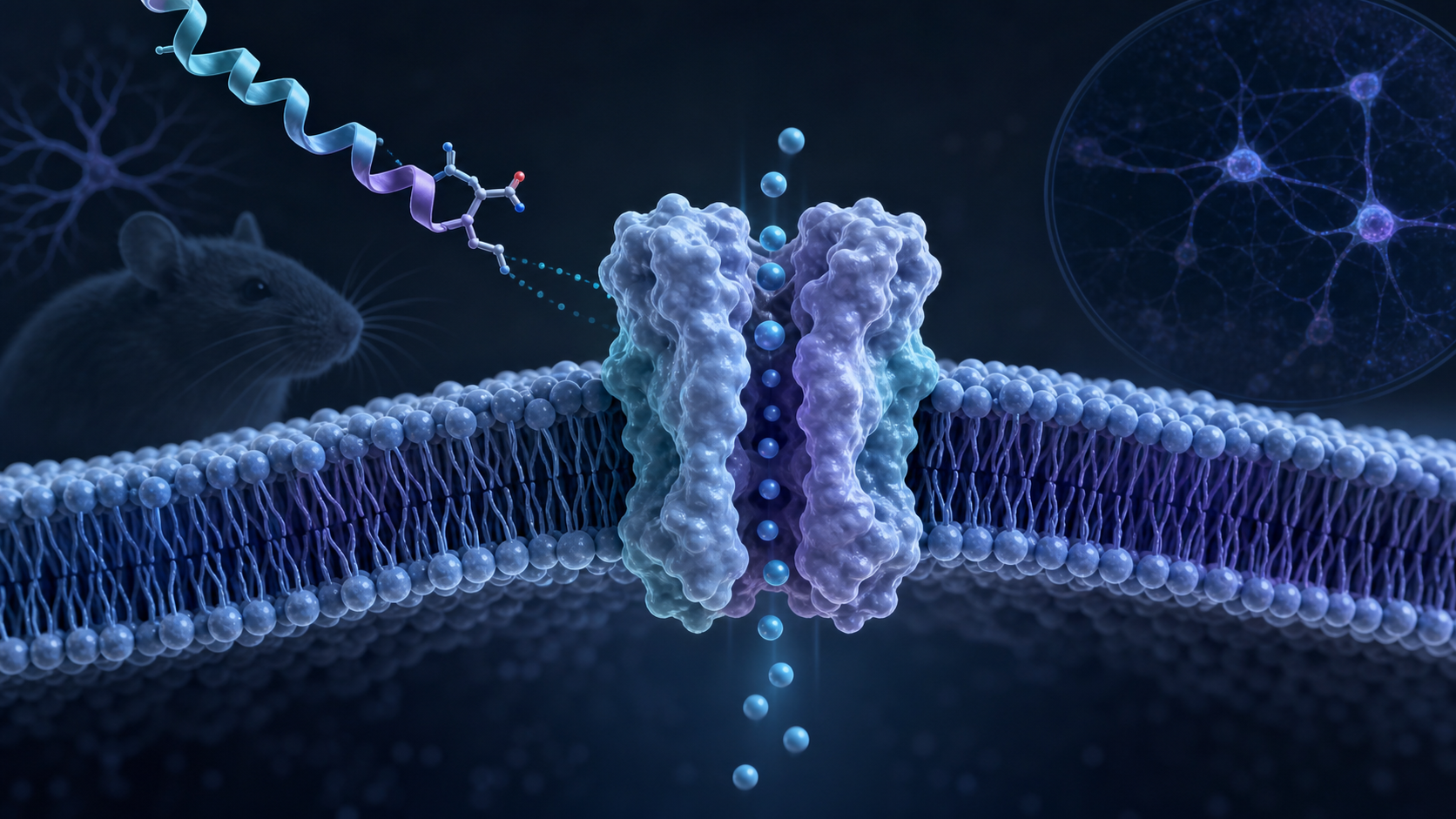
The published evidence directly concerning PE-22-28 is limited to preclinical research. A 2017 study evaluated shortened spadin analogs and reported that PE-22-28 inhibited TREK-1, produced antidepressant-like findings in mouse behavioral models, and was associated with measures of neurogenesis and synaptogenesis in experimental systems [pubmed:28955242].
These findings support PE-22-28 as an experimental TREK-1-modulating peptide with biological activity in cellular assays and mouse models. They do not demonstrate that PE-22-28 treats depression, improves cognition, protects the human nervous system, or produces any other clinically meaningful outcome in people.
The available evidence set also does not establish human pharmacokinetics, bioavailability, effective exposure, adverse-event frequency, dose-response relationships, long-term effects, interaction risks, or tolerability. Conclusions about human or veterinary use would therefore require evidence that is not present in the collected literature.
What Was Tested in Humans?
No controlled human intervention data were identified in the available evidence set used for this draft. That does not mean the compound has no research interest; it means human outcome claims should not be made from this article’s source base.
What Did Animal and Mechanistic Studies Show?
The available evidence set should be interpreted carefully when it includes animal, cellular, formulation, or mechanistic findings. Those findings can explain why researchers study the compound, but they should not be presented as established human outcomes.
How the Evidence Fits Together
The practical reading for PE-22-28 is evidence hierarchy. Human studies, when present, carry the most weight, but only for the exact population, route, comparator, and endpoint studied. Reviews can help map the field, and animal or mechanistic studies can explain biological plausibility, but neither should be used to leap beyond the human evidence.
What Is Not Established
Based on the available evidence set, the following have not been established:
Antidepressant efficacy for PE-22-28 in humans.
Cognitive enhancement or measurable improvement in human cognitive performance.
Neuroprotective effects or improved neurological outcomes in humans.
Treatment effects in stroke, post-stroke depression, or other neurological conditions.
Human safety, tolerability, or adverse-event rates.
Long-term effects of exposure.
Human pharmacokinetics, bioavailability, or effective exposure ranges.
Clinical selectivity for TREK-1 relative to other biological targets.
Therapeutic equivalence between PE-22-28, parent spadin, and other spadin analogs.
Metabolic, pancreatic, anti-inflammatory, or anti-aging effects attributable to PE-22-28.
Any evidence-based dosing or administration framework.
Clinical utility for any human or veterinary indication.
The published research therefore supports a cautious conclusion: PE-22-28 is an experimental shortened spadin analog with reported TREK-1 inhibition and preclinical activity in cellular and mouse models. The broader spadin and TREK-1 literature supplies a mechanistic rationale for continued investigation, but it does not convert the existing evidence into proof of efficacy or safety in humans.
Research-Use Boundary
This article summarizes published research and regulatory-source discussion for technical review. It is not medical advice, not a dosing guide, and not a recommendation for human or veterinary use. KRL materials are sold for research use only and are not for diagnostic, therapeutic, or administration purposes.
Selected Sources
[pubmed:28955242] Shortened Spadin Analogs Display Better TREK-1 Inhibition, In Vivo Stability and Antidepressant Activity.
[pubmed:30291907] Fighting against depression with TREK-1 blockers: Past and future. A focus on spadin.
[pubmed:20405001] Spadin, a sortilin-derived peptide, targeting rodent TREK-1 channels: a new concept in the antidepressant drug design.
[pubmed:25598009] In vitro and in vivo regulation of synaptogenesis by the novel antidepressant spadin.
[pubmed:32317978] Spadin Selectively Antagonizes Arachidonic Acid Activation of TREK-1 Channels.
[pubmed:21807005] Spadin as a new antidepressant: absence of TREK-1-related side effects.
[pubmed:25080852] Retroinverso analogs of spadin display increased antidepressant effects.
[pubmed:33737242] Sortilin-derived peptides promote pancreatic beta-cell survival through CREB signaling pathway.
[pubmed:27816451] Sortilin derived propeptide regulation during adipocyte differentiation and inflammation.
[pubmed:31325429] First evidence of protective effects on stroke recovery and post-stroke depression induced by sortilin-derived peptides.
Related KRL Resources
Need current product documentation or small-order review? Small-quantity qualified research purchasers can send a KRL10 order-review request, request current COA availability, review product documentation, or use the catalog-access support path from Kratos Research Labs.
1st Time Customers Receive 10% off their 1st order over $100.00 with CODE KRL10
Research use only. Not for human or veterinary use. Payment instructions are provided after compliance review.