Author: mollybolt

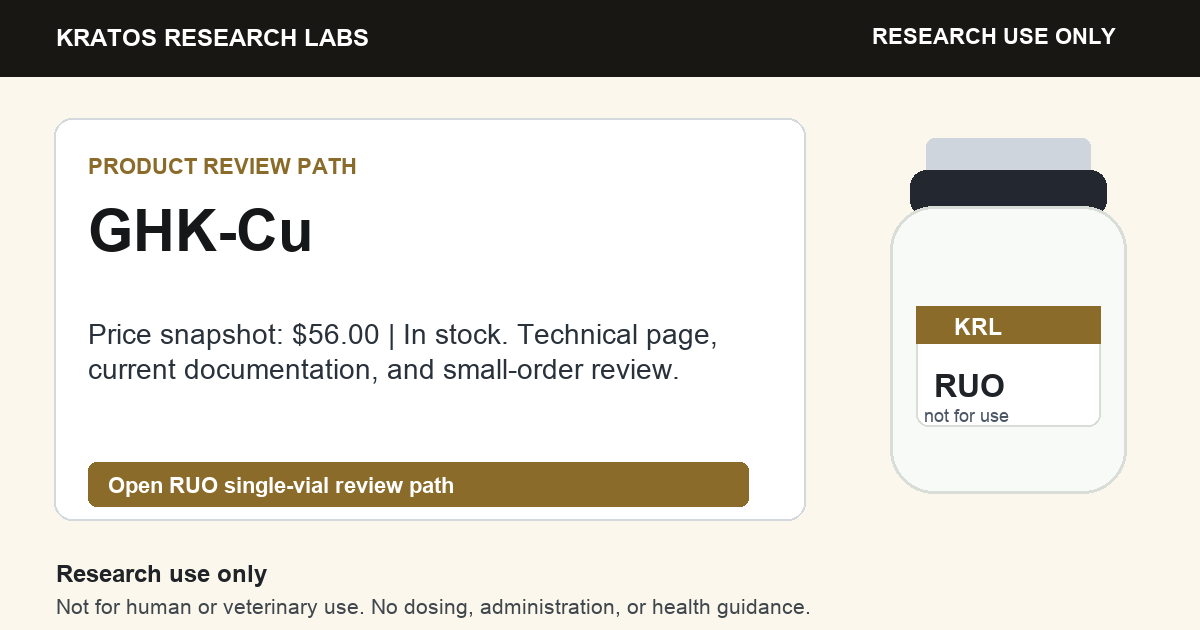
  • GHK-Cu RUO Technical Review Path

    GHK-Cu RUO Technical Review Path

    Kratos Research Labs keeps the RUO review path for GHK-Cu focused on product identity, documentation, small-order review, and catalog access after RUO acknowledgement.

    This page is a product-specific entry point for qualified RUO purchasers and technical reviewers comparing documentation paths. It does not provide use, dosing, administration, treatment, diagnostic, human, veterinary, health, bodybuilding, weight-loss, or personal-use guidance.

    GHK-Cu RUO review path

    1. Start with the public technical page for product identity and labeled amount.
    2. Request current COA availability or product documentation when documentation is needed before ordering.
    3. Use the small-order request path for qualified RUO review, payment-instruction review after compliance review, or order-support routing.
    4. Use the gated catalog only after reviewing the RUO catalog-access preflight and acknowledging the RUO limitation.

    Launch-week RUO catalog incentive: Code KRL10 gives $10 off eligible RUO catalog orders of $100 or more for the first 10 coupon uses through June 4, 2026.

    Research use only. Not for human or veterinary use. Coupon availability does not change the RUO-only limitation or compliance review path.

    Related RUO review resources

    Need current product documentation or small-order review? Small-quantity qualified research purchasers can send a KRL10 order-review request, request current COA availability, review product documentation, or use the catalog-access support path from Kratos Research Labs.

    Launch-week incentive: Use code KRL10 for $10 off eligible RUO catalog orders of $100 or more. Limited to the first 10 coupon uses, one use per customer, through June 4, 2026.

    Research use only. Not for human or veterinary use. Payment instructions are provided after compliance review.
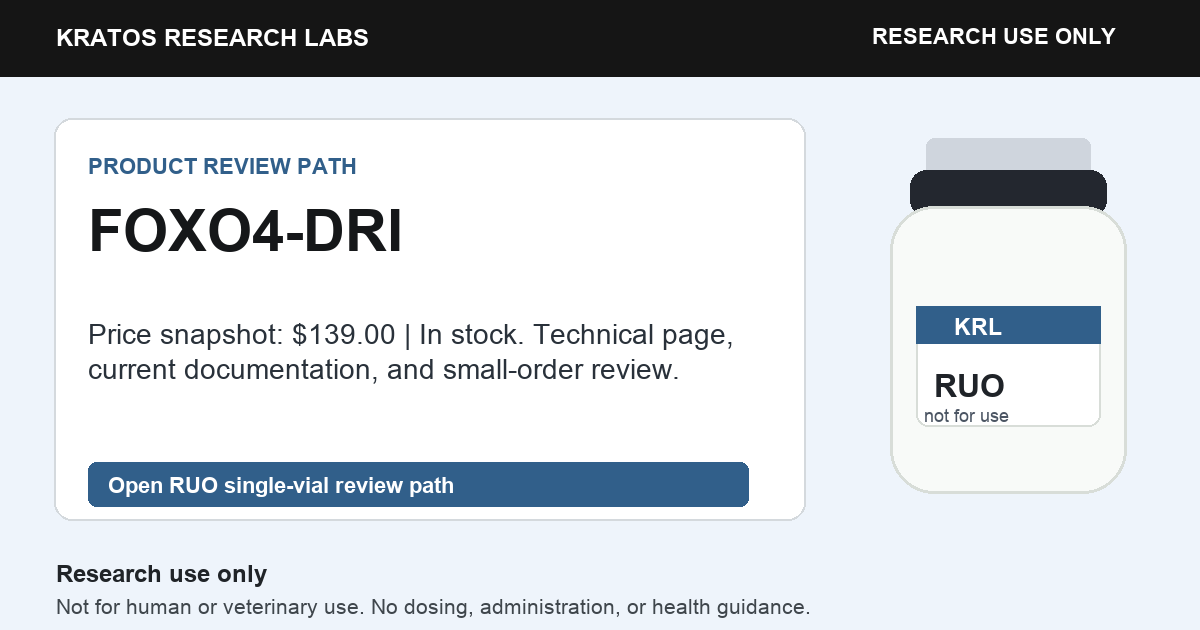
  • FOXO4-DRI RUO Technical Review Path

    FOXO4-DRI RUO Technical Review Path

    Kratos Research Labs keeps the RUO review path for FOXO4-DRI focused on product identity, documentation, small-order review, and catalog access after RUO acknowledgement.

    This page is a product-specific entry point for qualified RUO purchasers and technical reviewers comparing documentation paths. It does not provide use, dosing, administration, treatment, diagnostic, human, veterinary, health, bodybuilding, weight-loss, or personal-use guidance.

    FOXO4-DRI RUO review path

    1. Start with the public technical page for product identity and labeled amount.
    2. Request current COA availability or product documentation when documentation is needed before ordering.
    3. Use the small-order request path for qualified RUO review, payment-instruction review after compliance review, or order-support routing.
    4. Use the gated catalog only after reviewing the RUO catalog-access preflight and acknowledging the RUO limitation.

    Launch-week RUO catalog incentive: Code KRL10 gives $10 off eligible RUO catalog orders of $100 or more for the first 10 coupon uses through June 4, 2026.

    Research use only. Not for human or veterinary use. Coupon availability does not change the RUO-only limitation or compliance review path.

    Related RUO review resources

    Need current product documentation or small-order review? Small-quantity qualified research purchasers can send a KRL10 order-review request, request current COA availability, review product documentation, or use the catalog-access support path from Kratos Research Labs.

    Launch-week incentive: Use code KRL10 for $10 off eligible RUO catalog orders of $100 or more. Limited to the first 10 coupon uses, one use per customer, through June 4, 2026.

    Research use only. Not for human or veterinary use. Payment instructions are provided after compliance review.
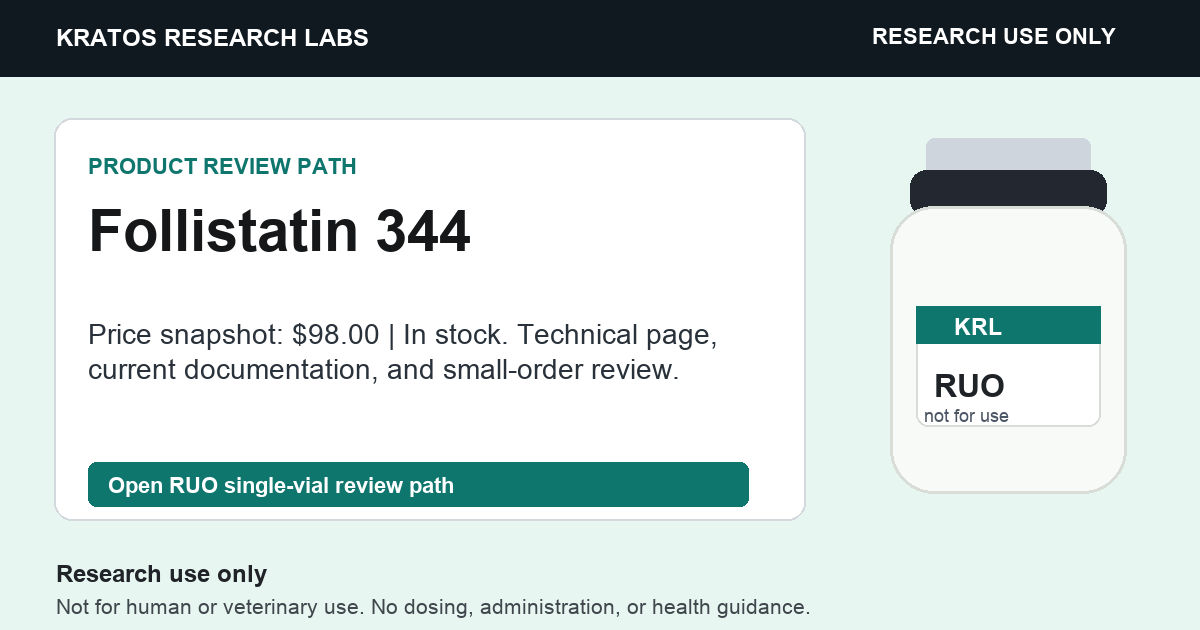
  • Follistatin 344 RUO Technical Review Path

    Follistatin 344 RUO Technical Review Path

    Kratos Research Labs keeps the RUO review path for Follistatin 344 focused on product identity, documentation, small-order review, and catalog access after RUO acknowledgement.

    This page is a product-specific entry point for qualified RUO purchasers and technical reviewers comparing documentation paths. It does not provide use, dosing, administration, treatment, diagnostic, human, veterinary, health, bodybuilding, weight-loss, or personal-use guidance.

    Follistatin 344 RUO review path

    1. Start with the public technical page for product identity and labeled amount.
    2. Request current COA availability or product documentation when documentation is needed before ordering.
    3. Use the small-order request path for qualified RUO review, payment-instruction review after compliance review, or order-support routing.
    4. Use the gated catalog only after reviewing the RUO catalog-access preflight and acknowledging the RUO limitation.

    Launch-week RUO catalog incentive: Code KRL10 gives $10 off eligible RUO catalog orders of $100 or more for the first 10 coupon uses through June 4, 2026.

    Research use only. Not for human or veterinary use. Coupon availability does not change the RUO-only limitation or compliance review path.

    Related RUO review resources

    Need current product documentation or small-order review? Small-quantity qualified research purchasers can send a KRL10 order-review request, request current COA availability, review product documentation, or use the catalog-access support path from Kratos Research Labs.

    Launch-week incentive: Use code KRL10 for $10 off eligible RUO catalog orders of $100 or more. Limited to the first 10 coupon uses, one use per customer, through June 4, 2026.

    Research use only. Not for human or veterinary use. Payment instructions are provided after compliance review.
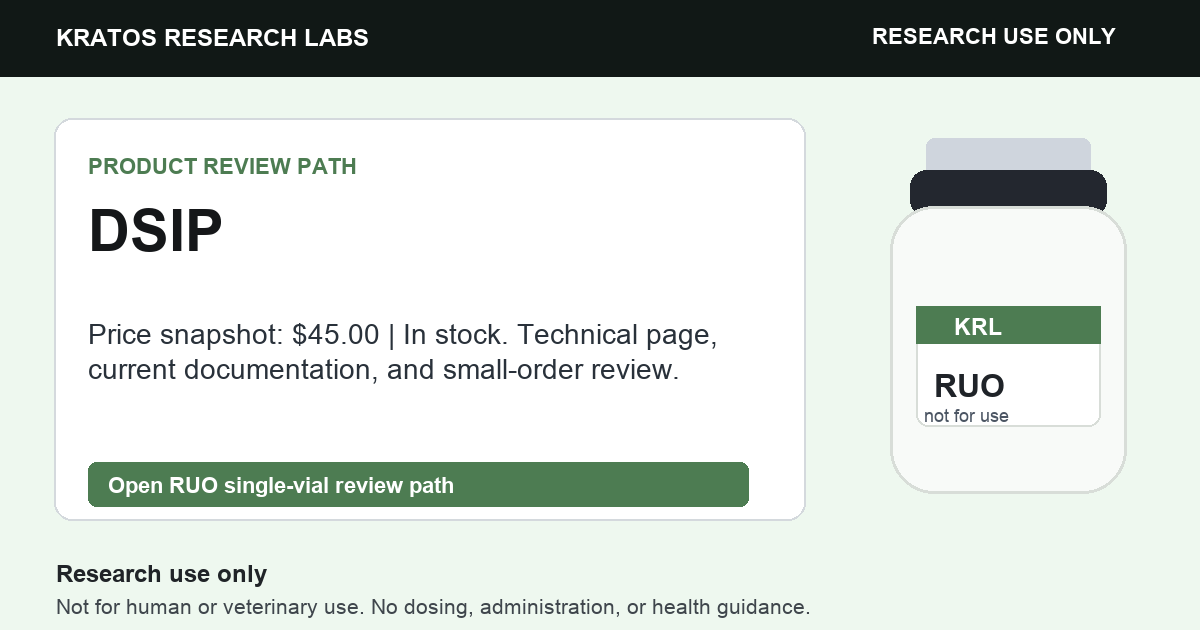
  • DSIP RUO Technical Review Path

    DSIP RUO Technical Review Path

    Kratos Research Labs keeps the RUO review path for DSIP focused on product identity, documentation, small-order review, and catalog access after RUO acknowledgement.

    This page is a product-specific entry point for qualified RUO purchasers and technical reviewers comparing documentation paths. It does not provide use, dosing, administration, treatment, diagnostic, human, veterinary, health, bodybuilding, weight-loss, or personal-use guidance.

    DSIP RUO review path

    1. Start with the public technical page for product identity and labeled amount.
    2. Request current COA availability or product documentation when documentation is needed before ordering.
    3. Use the small-order request path for qualified RUO review, payment-instruction review after compliance review, or order-support routing.
    4. Use the gated catalog only after reviewing the RUO catalog-access preflight and acknowledging the RUO limitation.

    Launch-week RUO catalog incentive: Code KRL10 gives $10 off eligible RUO catalog orders of $100 or more for the first 10 coupon uses through June 4, 2026.

    Research use only. Not for human or veterinary use. Coupon availability does not change the RUO-only limitation or compliance review path.

    Related RUO review resources

    Need current product documentation or small-order review? Small-quantity qualified research purchasers can send a KRL10 order-review request, request current COA availability, review product documentation, or use the catalog-access support path from Kratos Research Labs.

    Launch-week incentive: Use code KRL10 for $10 off eligible RUO catalog orders of $100 or more. Limited to the first 10 coupon uses, one use per customer, through June 4, 2026.

    Research use only. Not for human or veterinary use. Payment instructions are provided after compliance review.
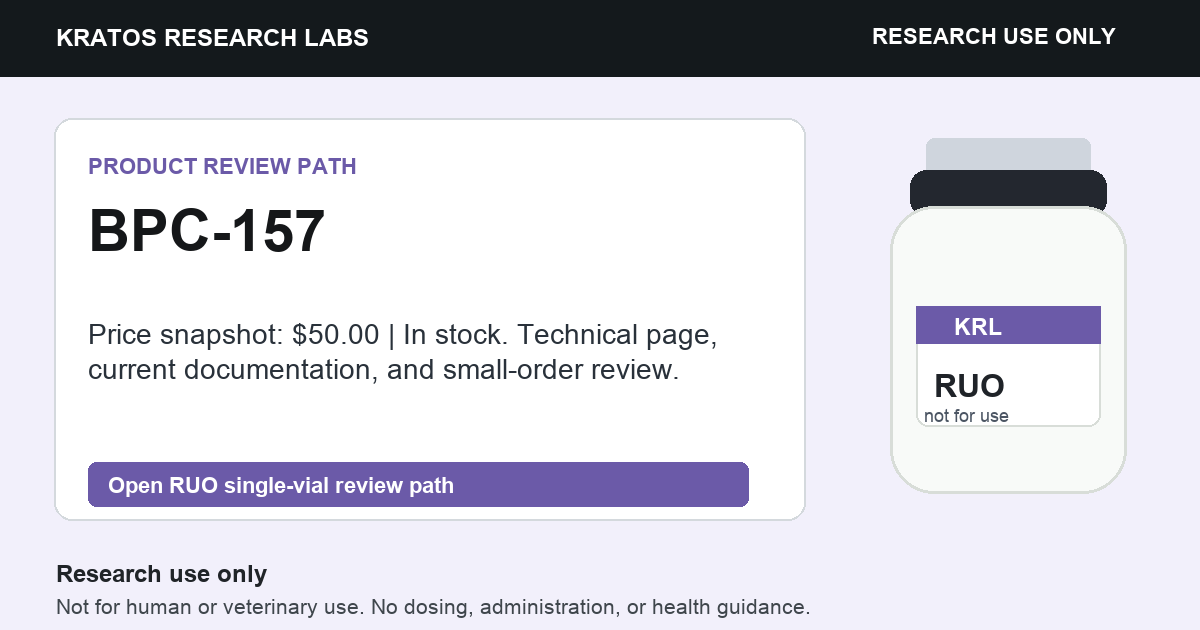
  • BPC-157 RUO Technical Review Path

    BPC-157 RUO Technical Review Path

    Kratos Research Labs keeps the RUO review path for BPC-157 focused on product identity, documentation, small-order review, and catalog access after RUO acknowledgement.

    This page is a product-specific entry point for qualified RUO purchasers and technical reviewers comparing documentation paths. It does not provide use, dosing, administration, treatment, diagnostic, human, veterinary, health, bodybuilding, weight-loss, or personal-use guidance.

    BPC-157 RUO review path

    1. Start with the public technical page for product identity and labeled amount.
    2. Request current COA availability or product documentation when documentation is needed before ordering.
    3. Use the small-order request path for qualified RUO review, payment-instruction review after compliance review, or order-support routing.
    4. Use the gated catalog only after reviewing the RUO catalog-access preflight and acknowledging the RUO limitation.

    Launch-week RUO catalog incentive: Code KRL10 gives $10 off eligible RUO catalog orders of $100 or more for the first 10 coupon uses through June 4, 2026.

    Research use only. Not for human or veterinary use. Coupon availability does not change the RUO-only limitation or compliance review path.

    Related RUO review resources

    Need current product documentation or small-order review? Small-quantity qualified research purchasers can send a KRL10 order-review request, request current COA availability, review product documentation, or use the catalog-access support path from Kratos Research Labs.

    Launch-week incentive: Use code KRL10 for $10 off eligible RUO catalog orders of $100 or more. Limited to the first 10 coupon uses, one use per customer, through June 4, 2026.

    Research use only. Not for human or veterinary use. Payment instructions are provided after compliance review.
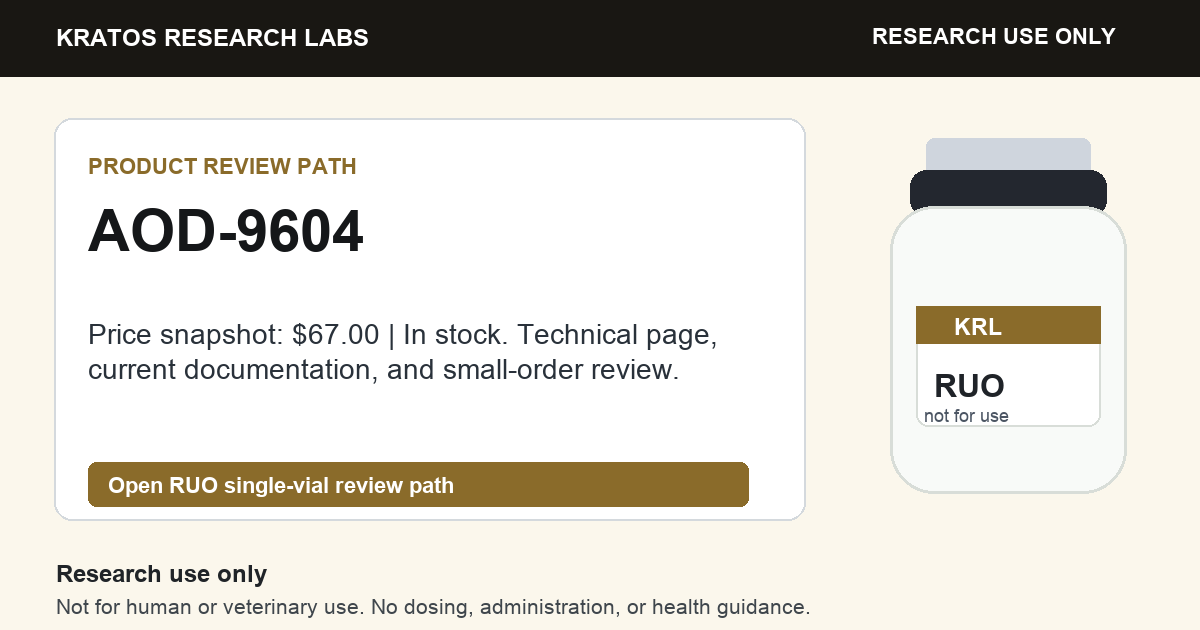
  • AOD-9604 RUO Technical Review Path

    AOD-9604 RUO Technical Review Path

    Kratos Research Labs keeps the RUO review path for AOD-9604 focused on product identity, documentation, small-order review, and catalog access after RUO acknowledgement.

    This page is a product-specific entry point for qualified RUO purchasers and technical reviewers comparing documentation paths. It does not provide use, dosing, administration, treatment, diagnostic, human, veterinary, health, bodybuilding, weight-loss, or personal-use guidance.

    AOD-9604 RUO review path

    1. Start with the public technical page for product identity and labeled amount.
    2. Request current COA availability or product documentation when documentation is needed before ordering.
    3. Use the small-order request path for qualified RUO review, payment-instruction review after compliance review, or order-support routing.
    4. Use the gated catalog only after reviewing the RUO catalog-access preflight and acknowledging the RUO limitation.

    Launch-week RUO catalog incentive: Code KRL10 gives $10 off eligible RUO catalog orders of $100 or more for the first 10 coupon uses through June 4, 2026.

    Research use only. Not for human or veterinary use. Coupon availability does not change the RUO-only limitation or compliance review path.

    Related RUO review resources

    Need current product documentation or small-order review? Small-quantity qualified research purchasers can send a KRL10 order-review request, request current COA availability, review product documentation, or use the catalog-access support path from Kratos Research Labs.

    Launch-week incentive: Use code KRL10 for $10 off eligible RUO catalog orders of $100 or more. Limited to the first 10 coupon uses, one use per customer, through June 4, 2026.

    Research use only. Not for human or veterinary use. Payment instructions are provided after compliance review.

  • How People Talk About HGH, GHRPs, and GHRHs

    Context and Disclaimer

    This blog article is an anecdotal open-web listening summary. It reflects popular belief, forum-style discussion, clinic-blog framing, vendor/SEO-blog language, and recurring user expectations. It is not a scientific evidence review, not medical advice, not dosing guidance, and not a recommendation for human or veterinary use.

    The public conversation around HGH, GHRPs, and GHRHs is mostly about the role of growth hormone, how GHRH-style and GHRP-style peptides are believed to influence GH pulses, and why people distinguish direct HGH from secretagogues. That does not prove these effects occur. It does explain why people search for it, what they hope to notice, and where disappointment tends to appear when expectations outrun real-world experience.

    Key Takeaway

    Popular discussion around HGH, GHRPs, and GHRHs tends to cluster around the role of growth hormone, how GHRH-style and GHRP-style peptides are believed to influence GH pulses, and why people distinguish direct HGH from secretagogues. Positive reports usually describe gradual or subtle changes. Negative reports often describe non-response, vague effects, or difficulty separating the compound from training, nutrition, sleep, recovery time, and other simultaneous changes.

    The Popular Mechanism Story

    Human growth hormone is commonly discussed as a pituitary hormone involved in growth, tissue maintenance, metabolism, sleep-stage physiology, and downstream IGF-1 signaling. In popular peptide discussion, direct HGH is usually treated as different from secretagogues: direct HGH adds the hormone externally, while GHRH-style and GHRP-style compounds are discussed as signals that may influence the body’s own pulse-like GH release.

    GHRH-style compounds, such as sermorelin, CJC-1295, and tesamorelin in common online discussion, are usually described as acting closer to the “release hormone” side of the axis. GHRP-style compounds, such as ipamorelin, GHRP-2, GHRP-6, and hexarelin, are commonly described as ghrelin-receptor or secretagogue-style signals that may amplify or provoke GH-release patterns. That is the popular model people use when comparing these categories. It should not be treated as a dosing guide, a clinical claim, or proof that a given compound produces a predictable human outcome.

    Reported Expected Effects

    People commonly expect HGH, GHRPs, and GHRHs to support:

    • supporting natural GH-pulse signaling.
    • recovery and sleep expectations.
    • body-composition interest.
    • interest in IGF-1 as a downstream signal.

    These are expectations and anecdotes, not validated outcomes. In the blog lane, the useful question is not “what has been proven?” but “what are people expecting, and what do they say they notice?”

    Reported Unexpected Effects

    People often conflate direct HGH, GHRH analogs, and GHRPs even though the popular mechanism story is different. Some expect dramatic effects but report subtle or slow changes.

    This is a recurring pattern in anecdotal peptide discussion: some people expect an obvious signal and instead describe a quiet or ambiguous experience. Others report something adjacent to the main claim, such as changes in sleep, appetite, soreness, mood, or perceived recovery.

    Reported Benefits

    The most common benefit language centers on sleep, recovery, body composition, tissue-repair expectations, and broader hormonal-axis interest. People who describe a positive experience often use cautious words such as “subtle,” “gradual,” “supportive,” or “helpful alongside other changes.” That matters because it is very different from saying the compound reliably causes the result.

    Reported Side Effects and Complaints

    Common complaints in open-web discussion include water retention, hunger with some GHRP discussions, joint stiffness, tingling, glucose concerns, and non-response. The most important complaint is usually non-response. A large share of peptide discussion is built around expectations, and expectation-heavy topics can create disappointment when the perceived effect is mild, delayed, or impossible to attribute.

    Non-Response and Mixed Experiences

    The mixed-experience pattern is central to reading these articles correctly. Popularity does not mean reliability. A compound can be widely discussed because people want a certain outcome, because marketing repeats a claim, or because early adopters share dramatic stories. That does not mean every user reports the same thing.

    For HGH, GHRPs, and GHRHs, the honest blog framing is that people discuss it because of the role of growth hormone, how GHRH-style and GHRP-style peptides are believed to influence GH pulses, and why people distinguish direct HGH from secretagogues, while reports vary and many claims remain anecdotal.

    Where Claims Tend To Come From

    For this article, KRL treated the blog lane as an open-web listening channel. The source categories include growth-hormone physiology explainers, clinic blogs, peptide education pages, and user discussions about sermorelin, CJC-1295, ipamorelin, GHRP-2, GHRP-6, and hexarelin. These sources are useful for understanding demand, perception, and recurring user language. They are not a substitute for controlled research.

    Related KRL Resources

    What This Does Not Establish

    This article does not establish that HGH, GHRPs, and GHRHs causes the effects people discuss online. It does not establish safety, efficacy, suitability, mechanism, dosing, frequency, or expected results. It does not recommend human or veterinary use.

    Reported-experience posts are listening summaries. Research summaries belong in the Research Library; product and catalog pages remain research-use-only.

    FAQ

    Q: Is this a scientific article? A: No. This is a blog-channel summary of popular belief and reported experience patterns. It is not a Research Summary.

    Q: Does KRL verify that these reported effects are real? A: No. KRL is describing recurring claims and complaints, not validating them.

    Q: Why include anecdotal content at all? A: It helps separate what people believe and expect from what the published research actually supports. That distinction keeps the blog lane and Research Library from collapsing into one another.

    Q: Does this article include dosing or usage guidance? A: No. It does not include dosing, protocols, stacking, cycling, administration guidance, or recommendations for human/veterinary use.

    Source Notes

    • Source type: open-web listening summary based on recurring themes in growth-hormone physiology explainers, clinic blogs, peptide education pages, and user discussions about sermorelin, CJC-1295, ipamorelin, GHRP-2, GHRP-6, and hexarelin.
    • Channel: KRL Blog / Reported Experiences.
    • Evidence status: anecdotal and perception-focused only; not a scientific evidence review.

    Need current product documentation or small-order review? Small-quantity qualified research purchasers can send a KRL10 order-review request, request current COA availability, review product documentation, or use the catalog-access support path from Kratos Research Labs.

    Launch-week incentive: Use code KRL10 for $10 off eligible RUO catalog orders of $100 or more. Limited to the first 10 coupon uses, one use per customer, through June 4, 2026.

    Research use only. Not for human or veterinary use. Payment instructions are provided after compliance review.

  • What People Report Experiencing With MOTS-C

    Context and Disclaimer

    This blog article is an anecdotal open-web listening summary. It reflects popular belief, forum-style discussion, clinic-blog framing, vendor/SEO-blog language, and recurring user expectations. It is not a scientific evidence review, not medical advice, not dosing guidance, and not a recommendation for human or veterinary use.

    The public conversation around MOTS-C is mostly about mitochondrial support, energy, endurance, metabolic flexibility, and body-composition expectations. That does not prove these effects occur. It does explain why people search for it, what they hope to notice, and where disappointment tends to appear when expectations outrun real-world experience.

    Key Takeaway

    Popular discussion around MOTS-C tends to cluster around mitochondrial support, energy, endurance, metabolic flexibility, and body-composition expectations. Positive reports usually describe gradual or subtle changes. Negative reports often describe non-response, vague effects, or difficulty separating the compound from training, nutrition, sleep, recovery time, and other simultaneous changes.

    Reported Expected Effects

    People commonly expect MOTS-C to support:

    • better stamina.
    • improved training tolerance.
    • more stable energy.
    • metabolic or body-composition support.

    These are expectations and anecdotes, not validated outcomes. In the blog lane, the useful question is not “what has been proven?” but “what are people expecting, and what do they say they notice?”

    Reported Unexpected Effects

    Some people report fatigue instead of stimulation. Others describe a slow background effect rather than a clear acute change.

    This is a recurring pattern in anecdotal peptide discussion: some people expect an obvious signal and instead describe a quiet or ambiguous experience. Others report something adjacent to the main claim, such as changes in sleep, appetite, soreness, mood, or perceived recovery.

    Reported Benefits

    The most common benefit language centers on energy, exercise capacity, metabolic-interest framing, and recovery confidence. People who describe a positive experience often use cautious words such as “subtle,” “gradual,” “supportive,” or “helpful alongside other changes.” That matters because it is very different from saying the compound reliably causes the result.

    Reported Side Effects and Complaints

    Common complaints in open-web discussion include no response, fatigue, headache, injection-site irritation in anecdotal reports, and uncertainty about whether training changes caused the improvement. The most important complaint is usually non-response. A large share of peptide discussion is built around expectations, and expectation-heavy topics can create disappointment when the perceived effect is mild, delayed, or impossible to attribute.

    Non-Response and Mixed Experiences

    The mixed-experience pattern is central to reading these articles correctly. Popularity does not mean reliability. A compound can be widely discussed because people want a certain outcome, because marketing repeats a claim, or because early adopters share dramatic stories. That does not mean every user reports the same thing.

    For MOTS-C, the honest blog framing is that people discuss it because of mitochondrial support, energy, endurance, metabolic flexibility, and body-composition expectations, while reports vary and many claims remain anecdotal.

    Where Claims Tend To Come From

    For this article, KRL treated the blog lane as an open-web listening channel. The source categories include mitochondrial-health blogs, peptide explainers, user forums, and clinic-style pages. These sources are useful for understanding demand, perception, and recurring user language. They are not a substitute for controlled research.

    Related KRL Resources

    What This Does Not Establish

    This article does not establish that MOTS-C causes the effects people discuss online. It does not establish safety, efficacy, suitability, mechanism, dosing, frequency, or expected results. It does not recommend human or veterinary use.

    Reported-experience posts are listening summaries. Research summaries belong in the Research Library; product and catalog pages remain research-use-only.

    FAQ

    Q: Is this a scientific article? A: No. This is a blog-channel summary of popular belief and reported experience patterns. It is not a Research Summary.

    Q: Does KRL verify that these reported effects are real? A: No. KRL is describing recurring claims and complaints, not validating them.

    Q: Why include anecdotal content at all? A: It helps separate what people believe and expect from what the published research actually supports. That distinction keeps the blog lane and Research Library from collapsing into one another.

    Q: Does this article include dosing or usage guidance? A: No. It does not include dosing, protocols, stacking, cycling, administration guidance, or recommendations for human/veterinary use.

    Source Notes

    • Source type: open-web listening summary based on recurring themes in mitochondrial-health blogs, peptide explainers, user forums, and clinic-style pages.
    • Channel: KRL Blog / Reported Experiences.
    • Evidence status: anecdotal and perception-focused only; not a scientific evidence review.

    Need current product documentation or small-order review? Small-quantity qualified research purchasers can send a KRL10 order-review request, request current COA availability, review product documentation, or use the catalog-access support path from Kratos Research Labs.

    Launch-week incentive: Use code KRL10 for $10 off eligible RUO catalog orders of $100 or more. Limited to the first 10 coupon uses, one use per customer, through June 4, 2026.

    Research use only. Not for human or veterinary use. Payment instructions are provided after compliance review.

  • What People Report Experiencing With Glutathione

    Context and Disclaimer

    This blog article is an anecdotal open-web listening summary. It reflects popular belief, forum-style discussion, clinic-blog framing, vendor/SEO-blog language, and recurring user expectations. It is not a scientific evidence review, not medical advice, not dosing guidance, and not a recommendation for human or veterinary use.

    The public conversation around Glutathione is mostly about antioxidant support, detox language, liver-support expectations, skin-brightness discussion, and recovery. That does not prove these effects occur. It does explain why people search for it, what they hope to notice, and where disappointment tends to appear when expectations outrun real-world experience.

    Key Takeaway

    Popular discussion around Glutathione tends to cluster around antioxidant support, detox language, liver-support expectations, skin-brightness discussion, and recovery. Positive reports usually describe gradual or subtle changes. Negative reports often describe non-response, vague effects, or difficulty separating the compound from training, nutrition, sleep, recovery time, and other simultaneous changes.

    Reported Expected Effects

    People commonly expect Glutathione to support:

    • general antioxidant support.
    • a cleaner or less inflamed feeling.
    • skin-brightness expectations.
    • support after periods of stress.

    These are expectations and anecdotes, not validated outcomes. In the blog lane, the useful question is not “what has been proven?” but “what are people expecting, and what do they say they notice?”

    Reported Unexpected Effects

    Some people focus on skin tone while others focus on liver, recovery, or immune support. Many describe subtle wellness effects rather than dramatic changes.

    This is a recurring pattern in anecdotal peptide discussion: some people expect an obvious signal and instead describe a quiet or ambiguous experience. Others report something adjacent to the main claim, such as changes in sleep, appetite, soreness, mood, or perceived recovery.

    Reported Benefits

    The most common benefit language centers on skin appearance language, recovery, oxidative-stress support, and general wellness framing. People who describe a positive experience often use cautious words such as “subtle,” “gradual,” “supportive,” or “helpful alongside other changes.” That matters because it is very different from saying the compound reliably causes the result.

    Reported Side Effects and Complaints

    Common complaints in open-web discussion include no visible effect, headache, digestive upset, sulfur-like odor/taste in some discussions, and frustration with vague detox claims. The most important complaint is usually non-response. A large share of peptide discussion is built around expectations, and expectation-heavy topics can create disappointment when the perceived effect is mild, delayed, or impossible to attribute.

    Non-Response and Mixed Experiences

    The mixed-experience pattern is central to reading these articles correctly. Popularity does not mean reliability. A compound can be widely discussed because people want a certain outcome, because marketing repeats a claim, or because early adopters share dramatic stories. That does not mean every user reports the same thing.

    For Glutathione, the honest blog framing is that people discuss it because of antioxidant support, detox language, liver-support expectations, skin-brightness discussion, and recovery, while reports vary and many claims remain anecdotal.

    Where Claims Tend To Come From

    For this article, KRL treated the blog lane as an open-web listening channel. The source categories include wellness blogs, skin/antioxidant discussions, clinic pages, and user forums. These sources are useful for understanding demand, perception, and recurring user language. They are not a substitute for controlled research.

    Related KRL Resources

    What This Does Not Establish

    This article does not establish that Glutathione causes the effects people discuss online. It does not establish safety, efficacy, suitability, mechanism, dosing, frequency, or expected results. It does not recommend human or veterinary use.

    Reported-experience posts are listening summaries. Research summaries belong in the Research Library; product and catalog pages remain research-use-only.

    FAQ

    Q: Is this a scientific article? A: No. This is a blog-channel summary of popular belief and reported experience patterns. It is not a Research Summary.

    Q: Does KRL verify that these reported effects are real? A: No. KRL is describing recurring claims and complaints, not validating them.

    Q: Why include anecdotal content at all? A: It helps separate what people believe and expect from what the published research actually supports. That distinction keeps the blog lane and Research Library from collapsing into one another.

    Q: Does this article include dosing or usage guidance? A: No. It does not include dosing, protocols, stacking, cycling, administration guidance, or recommendations for human/veterinary use.

    Source Notes

    • Source type: open-web listening summary based on recurring themes in wellness blogs, skin/antioxidant discussions, clinic pages, and user forums.
    • Channel: KRL Blog / Reported Experiences.
    • Evidence status: anecdotal and perception-focused only; not a scientific evidence review.

    Need current product documentation or small-order review? Small-quantity qualified research purchasers can send a KRL10 order-review request, request current COA availability, review product documentation, or use the catalog-access support path from Kratos Research Labs.

    Launch-week incentive: Use code KRL10 for $10 off eligible RUO catalog orders of $100 or more. Limited to the first 10 coupon uses, one use per customer, through June 4, 2026.

    Research use only. Not for human or veterinary use. Payment instructions are provided after compliance review.

  • What People Report Experiencing With NAD+

    Context and Disclaimer

    This blog article is an anecdotal open-web listening summary. It reflects popular belief, forum-style discussion, clinic-blog framing, vendor/SEO-blog language, and recurring user expectations. It is not a scientific evidence review, not medical advice, not dosing guidance, and not a recommendation for human or veterinary use.

    The public conversation around NAD+ is mostly about energy, cellular-aging language, mental clarity, recovery, and mitochondrial-support expectations. That does not prove these effects occur. It does explain why people search for it, what they hope to notice, and where disappointment tends to appear when expectations outrun real-world experience.

    Key Takeaway

    Popular discussion around NAD+ tends to cluster around energy, cellular-aging language, mental clarity, recovery, and mitochondrial-support expectations. Positive reports usually describe gradual or subtle changes. Negative reports often describe non-response, vague effects, or difficulty separating the compound from training, nutrition, sleep, recovery time, and other simultaneous changes.

    Reported Expected Effects

    People commonly expect NAD+ to support:

    • more energy.
    • clearer thinking.
    • better recovery from stress.
    • a wellness or longevity-support feel.

    These are expectations and anecdotes, not validated outcomes. In the blog lane, the useful question is not “what has been proven?” but “what are people expecting, and what do they say they notice?”

    Reported Unexpected Effects

    Some people describe a noticeable acute sensation while others report nothing obvious. The experience is often framed as general vitality rather than one specific outcome.

    This is a recurring pattern in anecdotal peptide discussion: some people expect an obvious signal and instead describe a quiet or ambiguous experience. Others report something adjacent to the main claim, such as changes in sleep, appetite, soreness, mood, or perceived recovery.

    Reported Benefits

    The most common benefit language centers on energy, mental clarity, recovery, wellness continuity, and anti-aging interest. People who describe a positive experience often use cautious words such as “subtle,” “gradual,” “supportive,” or “helpful alongside other changes.” That matters because it is very different from saying the compound reliably causes the result.

    Reported Side Effects and Complaints

    Common complaints in open-web discussion include nausea, flushing, headache, fatigue, no noticeable effect, and skepticism about broad longevity claims. The most important complaint is usually non-response. A large share of peptide discussion is built around expectations, and expectation-heavy topics can create disappointment when the perceived effect is mild, delayed, or impossible to attribute.

    Non-Response and Mixed Experiences

    The mixed-experience pattern is central to reading these articles correctly. Popularity does not mean reliability. A compound can be widely discussed because people want a certain outcome, because marketing repeats a claim, or because early adopters share dramatic stories. That does not mean every user reports the same thing.

    For NAD+, the honest blog framing is that people discuss it because of energy, cellular-aging language, mental clarity, recovery, and mitochondrial-support expectations, while reports vary and many claims remain anecdotal.

    Where Claims Tend To Come From

    For this article, KRL treated the blog lane as an open-web listening channel. The source categories include longevity blogs, clinic pages, wellness forums, and peptide/biochemistry explainers. These sources are useful for understanding demand, perception, and recurring user language. They are not a substitute for controlled research.

    Related KRL Resources

    What This Does Not Establish

    This article does not establish that NAD+ causes the effects people discuss online. It does not establish safety, efficacy, suitability, mechanism, dosing, frequency, or expected results. It does not recommend human or veterinary use.

    Reported-experience posts are listening summaries. Research summaries belong in the Research Library; product and catalog pages remain research-use-only.

    FAQ

    Q: Is this a scientific article? A: No. This is a blog-channel summary of popular belief and reported experience patterns. It is not a Research Summary.

    Q: Does KRL verify that these reported effects are real? A: No. KRL is describing recurring claims and complaints, not validating them.

    Q: Why include anecdotal content at all? A: It helps separate what people believe and expect from what the published research actually supports. That distinction keeps the blog lane and Research Library from collapsing into one another.

    Q: Does this article include dosing or usage guidance? A: No. It does not include dosing, protocols, stacking, cycling, administration guidance, or recommendations for human/veterinary use.

    Source Notes

    • Source type: open-web listening summary based on recurring themes in longevity blogs, clinic pages, wellness forums, and peptide/biochemistry explainers.
    • Channel: KRL Blog / Reported Experiences.
    • Evidence status: anecdotal and perception-focused only; not a scientific evidence review.

    Need current product documentation or small-order review? Small-quantity qualified research purchasers can send a KRL10 order-review request, request current COA availability, review product documentation, or use the catalog-access support path from Kratos Research Labs.

    Launch-week incentive: Use code KRL10 for $10 off eligible RUO catalog orders of $100 or more. Limited to the first 10 coupon uses, one use per customer, through June 4, 2026.

    Research use only. Not for human or veterinary use. Payment instructions are provided after compliance review.